Blog

  • Linkpost: Europeana 2025 videos

    A must watch for anyone in the cultural heritage sector

  • Linkpost: Botticelli v Warhol – 2025 Cultural Heritage Conference in Florence

    IP Kat (which is very much the blog to follow on legal news regarding so called intellectual property) published a 2 part guest post summarizing this conference in Florence:

    Day 1

    Day 2

  • Linkpost: 10 years of pomological watercolors

    10 years ago, Parker Higgins called for the publishing of a collection of pomological watercolors, click through for the details (but this is pretty famous in my corner of the internet): https://parkerhiggins.net/2025/04/10-years-of-pomological-watercolors

    What struck me while reading the 10-year-anniversary post was this quote:

    Through a handful of FOIA requests I’d learned that the images had been meticulously digitized and put online for purchase, but that less than 100 pictures had been sold that way — not nearly enough to justify the paywall.

    We previously wrote about the ongoing attempts at selling access to cultural heritage digitalisations that have long entered the public domain, as long as they’re owned by museums.

    The fundamental issue is that while it might be nice to generate revenue both for the institutions conserving the artifacts, and for the people doing the digitalisation (that’s us, ideally), there is simply not enough willingness to pay.

    There is also the moral question of creating a class of works which never truly join the public domain, but I’ve found it quite hard to argue with people about this, apparently the public domain is not a self-evident good thing for everyone.

    And of course there’s the latest hype, AI, which allows people both to attempt to profit from the public domain (by using it to train their models) and to trivially bypass paywalls (by just generating another image). This complicates the argument for the public domain, at least for those whose benefits are not self-evident.

    Yet, those benefits are there, and they are great.

  • In-person demo at Casa nel Parco

    We’ve been part of Officine On Off since October 2024, and last week we participated in their annual festival. There were games, music, and plenty of community feeling.

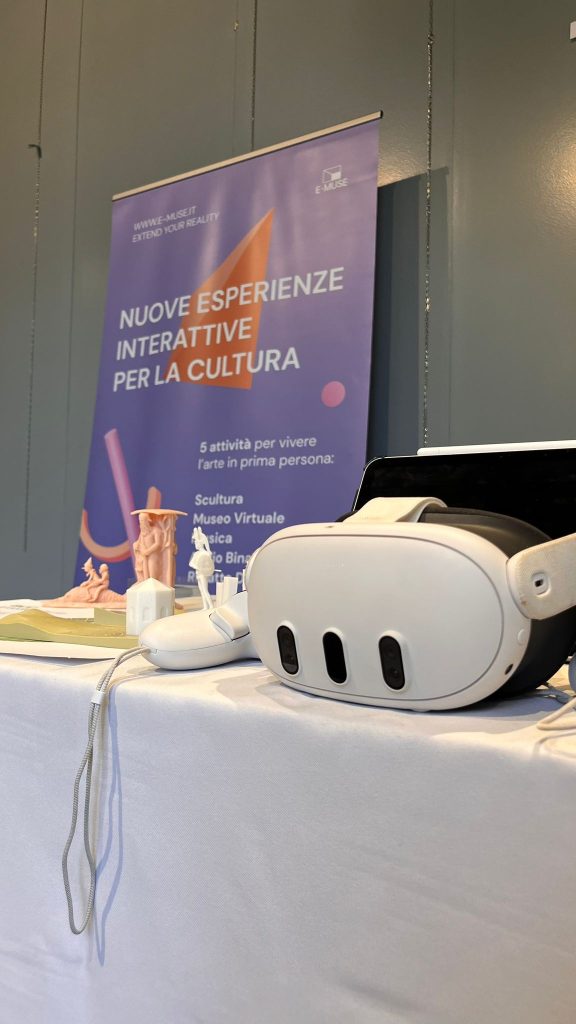
    We wanted to bring our A-game, so we even bought a roll-up, which sadly didn’t arrive in time due to a strike.

    A roll-up advertising immersive experiences, standing sadly in a living room

    We had:

    • 3D prints of statues that we had previously digitised, thanks to our dear friend Bonach
    • A glassless volumetric screen showing models and photos
    • A binaural audio guide for one of the 3D printed statues (written by Maura Rossi, with the voice of Chiara Gandini)
    • An Unreal Engine audio-visual simulation of Piazzale San Francesco in Parma, using data I obtained for Progetto Agorà
    • A local version of our Tempietto demo (web version with joystick controls or scrolling along a path), made in Unity, running on a Meta Quest 3, and featuring both the photogrammetry of Antelami’s Winter and the previously mentioned audioguide
    • 360° videos with Ambisonics audio, also running on the Meta Quest 3, mainly from the Verdi 360° project

    Despite the scorching weather, we had plenty of people ready to don the VR headset and to try out our demos. The only problem we faced was keeping the battery level up 😀

    Benny wearing the Meta Quest 3 in front of a crowd
    Benny and Furla assisting two visitors
    A teacher tries the Arte & Cultura experience on a laptop, sitting at an outdoor table
    Screenshot from the Unity experience, showing the overall layout

    Kids particularly enjoyed climbing the stairs, then throwing themselves into the void, they were universally delighted by the sensation, which I personally consider stomach-turning 😀

    We’ll have to sign up for more in-person demos, they’re just so much fun!

  • Our first in-person installation

    Our first in-person installation

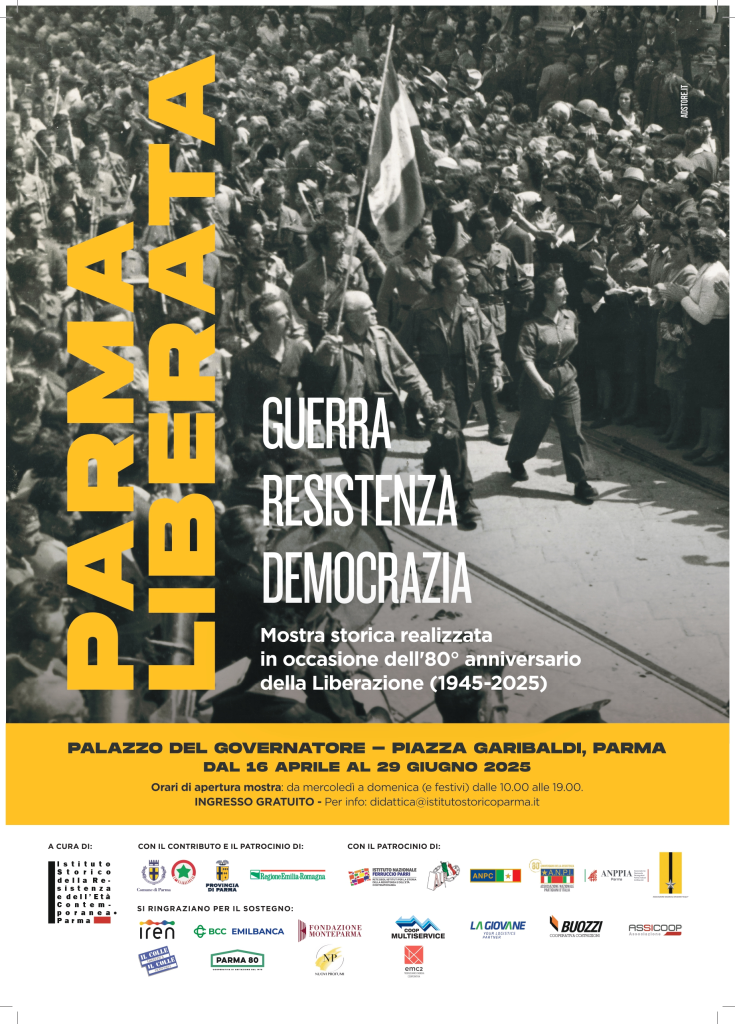
    This Tuesday our first in-person installation will be inaugurated.

    https://cultura.comune.parma.it/evento/it-IT/Parma-Liberata.aspx

    We created an immersive installation in the main room of the museum exhibit, in which the day of liberation takes life through its original footage.

    Come visit us before June 26th to experence it!

    As a bonus, here’s how we brough the video-projectors to the museum:

  • Basic sounds for a multi-platform game

    For the 2025 edition of the BCC Innovation Festival, we’re creating a little game, that will act as a sort of on-boarding for people looking to apply.

    In this game, a friendly robot will ask the player to solve some riddles and find some objects. This must not interfere with the audio stream, as users can talk to each other.

    Whenever the robot gives out information, it has a speech bubble and one of the yap sounds plays. There are several of these, and they’re meant to mimic an explanatory prosody.

    Whenever the player provides an incorrect answer, the nay chime is played.

    Finally, when a level is completed, we play the yeah sound. This is a longer joyful jingle, which would get annoying pretty quickly if it was overplayed.

    All these sounds were created by playing around with the 8-bit instrument package in Logic Pro. Except for the nay, they’re all built around major triads.

  • We’re on the local newspaper

    The Gazzetta di Parma, which is arguably the oldest newspaper in continuous operation in the world, ran an article about us and about the BCC Arte & Cultura project.

    Big thanks to the journalist, who did a great job in getting our ramblings into a coherent and understandable form!

  • Weird pseudoscience on YouTube Shorts – a debunking

    Last night I was mindlessly scrolling through YouTube Shorts, when I came across this: https://www.youtube.com/shorts/6BoCt6vo558

    It looks like a 3D reconstruction of the Fountain of the Lions from the Alhambra, taken from a longer show on the Alhambra water system.

    The comments are all slop about people not being stupid in the past, and about the fountain being built in Al-Andalus, in really weird tones.

    Here is the full video, which already has 2.7 million views, in just 3 weeks:

    The 3D and the animations are quite well done, unfortunately the actual content is mostly bullshit! The factual part seems to be largely inspired by this BCC Travel article from 2022.

    The central claim is about the Fountain of the Lions being a water clock. They have a textual version of each of their videos: https://primalnebula.com/the-engineering-of-the-alhambras-water-system/. The only source they have for the horological features is this “paper”, which is quite evidently devoid of any validity: https://ijisrt.com/assets/upload/files/IJISRT22JAN498.pdf

    If we look at the actual sources on the 2011 restoration of the fountain:

    There is no mention of the horological feature in any serious text, for the very simple reason that the fountain is not a clock! Water simply comes out of all twelve spigots.

    There are other basic physics mistakes, but I don’t understand why one would go to all the effort of doing all of this 3D reconstruction, all of these renders, just to spread lies on the internet. I guess the motive is actually quite clear: get millions of views, make lots of money.

  • New mesh reduction tools

    Holo Lab released this new Blender add-on that does a pretty job at reducing most photogrammetry models: https://github.com/HoloLabInc/ModerateWeightReductionTools

    It does fail on the more topologically challenged ones, but that is to be expected. As an example this 25MB model:

    Was reduced to this, which is just 295kB.

    I did remove the black background by hand, though.

    The interesting thing is that it added Sharps to edges automatically, you can see them in cyan.

    Of course the other interesting announcements in this field were Nvidia’s Meshtron and Microsoft’s Trellis (try it on hugginface), both of which do really interesting mesh generation.

    Of course for our requirements we cannot simply throw generative AI at the problem and hope for the best, we need to carefully represent the actual objects. But just as a try, we did try to throw an image of a bas-relief at Trellis. It created a plausible (but incorrect) result with a low-res texture. We tried throwing the original image on it as a texture, and it almost looked like it worked, until we tried moving the point of view.

    This is the original photo, it’s Il Lavoro by Pietro Palmisano, from the BCC Arte & Cultura catalogue.

    Generated model, with no texture:

    With the AI-generated texture

    With the original texture applied:

    It’s simultaneously very impressive, and not any good. We could try to salvage it by sculpting the most egregious parts, and we could do way better on the texture mapping.

    The geometry is really quite dense, we could try combining Trellis with Moderate Weight Reduction Tools.

    That really broke down. The geometry became visibly spiky, but the texture is just all wrong, it did not expect our “Project from View” trick.