Blog

  • BCC Arte e Cultura launch

    BCC Arte e Cultura launch

    We can finally talk about this! (If you look at the tags you might find a few related stealth posts)

    For the past year or so, we’ve been working on the cataloguing and digitalization project of the art and cultural heritage assets of the BCC ICCREA group.

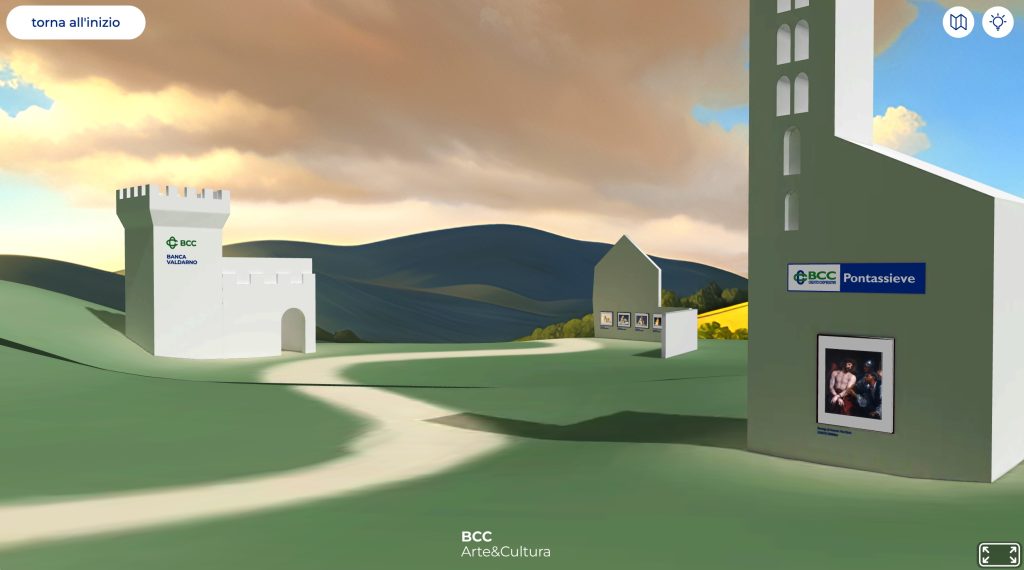
    Overall 59 banks and 109 works were included. The results were an art book, a digital catalogue, and a 3D gallery. We created 3D models of buildings and sculptures, we photographed a few paintings, and most importantly we created the 3D gallery.

    The project was announced in the rather wonderful Biblioteca Braidense, and it has already gained quite a bit of press:

    We’ll be back soon with a thorough log of what we did, and how we did it.

    (Also, there are still quite a few wrinkles to take care of, if you find any, drop us a line!)

  • They interviewed us

    They interviewed us

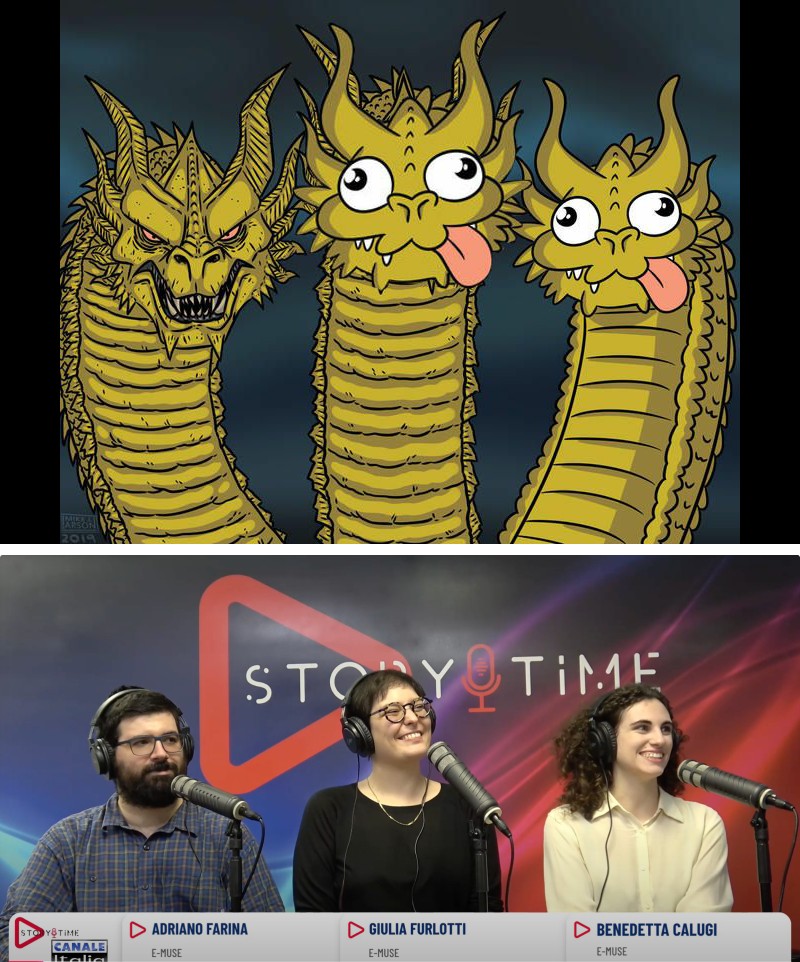
    We were interviewed by StoryTime, which is itself an interesting initiative to promote business and professionals in Emilia-Romagna. They were really friendly, and really put us at ease, which is not easy, we’re a skittish bunch 😀

  • New Creative Commons initiative for Cultural Heritage

    Creative Commons just launched the new TAROCH initiative, which is closely aligned with our goals. Go read the founding declaration: https://creativecommons.org/2024/11/01/creative-commons-launches-taroch-coalition-for-open-access-to-cultural-heritage/

  • Radio Interview, and how to download embedded audio from iOS

    Radio Interview, and how to download embedded audio from iOS

    On Tuesday (2024-10-29) we were interviewed by Story Time, and we broadcast on Radio Canale Italia yesterday.

    The interviewer was truly great, and everyone was simultaneously very friendly and very professional, we’d recommend them to anyone looking to promote their activity.

    In about a week we’ll be given the video and we’ll be able to share it with everyone, but in the meantime we wanted to save a copy of the audio, and I’m currently up a mountain, so I had to do it from an iPhone.

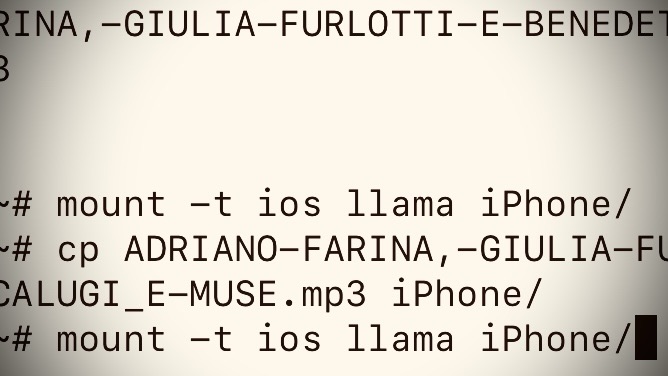
    Getting the mp3 url was pretty easy, I just had to go to the website in Safari, open the Web Inspector extension, and it was right there. I could open the mp3 directly in the browser, but while on an actual computer it would have been enough to right click and save it, on iOS I had to get a bit more involved. I used iSH to get a command line, downloaded the mp3 file with wget, and then I had to figure out how to get it out of the iSH sandbox.

    It turns out that you can just mount any folder.

    I created a download folder with

    mkdir Downloads

    Then I connected it to the Downloads folder on the iPhone filesystem with

    mount -t ios llama Downloads

    This opens up a graphical interface that lets you select which folder you wish to mount.

    I then simply copied the file to my Downloads with

    cp example.mp3 Downloads

    I guess the native iOS workflow would have been using Shortcuts, but I’m old.

  • Unsurprising legal case on commercial use of cultural heritage

    This case https://ipkitten.blogspot.com/2024/10/bologna-court-of-appeal-confirms-that.html is consistent with the Italian legislation. We hold that no image right should hold in perpetuity, and we really don’t understand which principle the Italian legislation is upholding.

    The simplest interpretation is that they think that they will create profits for cultural heritage institutions, which certainly could use funding. It doesn’t seem to produce this effect in reality, though.

    If they keep successfully suing commercial users, we think that the most likely outcome will be a diminished presence of Italian culture in commercial settings, and, in the long term, a loss of mind share. After all, there’s plenty of unencumbered art that is just as good.

  • Tech tip: recover from “ERROR MOOV atom not found”

    Today we had to give a video presentation for the technically unannounced BCC Arte & Cultura project, and that involved a whole lot of Blender animation renders. One of them, a long one that took hours in Cycles, crashed at the very end. We were exporting in mp4 format, which is easy to import in video editors, but is quite hard to recover if the file is not terminated correctly.

    VLC wouldn’t open it, and FFMPEG threw a “ERROR MOOV atom not found” warning, and then was unable to process any data.

    With no time to spare for another render pass, we found this forum thread: https://www.videohelp.com/software/recover-mp4-to-h264

    It’s a tiny and self-explanatory command-line utility, that saved us and gave us a usable file in seconds.

    The only problem is that it’s Windows only.

  • Go read: “Secret 3D Scans in the French Supreme Court”

    We’ve just read this post by the brilliant Cosmo Wenman of Concept Realizations.

    The cause is near and dear to us, doubly so because it involves Rodin’s The Thinker, which we have remixed for the BCC Innovation Festival.

    What we genuinely cannot understand is how people opposing the free distribution of our cultural heritage think of these issues. It is disconcerting, and we know that being unable to summarize the opposition’s views often signals a lack of genuine understanding.

  • WebXR is now supported on all major browsers

    https://x.com/AdaRoseCannon/status/1835739519766945793

    With the visionOS2 release Safari gains webXR support

  • Preparing immersive media for the Festival Day

    Preparing immersive media for the Festival Day

    In one week our work on the BCC Innovation Festival will culminate in an hybrid event, whose physical manifestation will be held in the Salone delle Colonne: an impressive looking immersive room in Rome’s EUR district.

    We are tasked with producing audiovisual material that shows off our immersive experiences in a context that is still immersive, but not interactive. In practice this means producing 360 videos, which have fewer rendering constraints (they don’t have to be executed in real time on random devices), but in which the visitor is less able to look around and explore.

    We’ll make sure to share this video when it is done, but for now I want to share how we managed to preview how the projection was going to look, without going all the way to Rome to try the system out in advance.

    A quick render of the Salone delle Colonne

    First of all we took the floor map of the space, which was available as a PDF on the venue’s website, we imported into Blender and we modelled a very simple mockup, using just cylinders for the walls and columns, and planes for the ceiling and floor.

    We also put in cubes to represent the positions of video projectors, but we didn’t bother to scale them correctly. We also didn’t model the sort of “steps” with which the ceiling lowers towards the sides of the room, as they don’t interact with the projection geometry.

    So far this was all straightforward modelling, the only somewhat non-obvious thing we did was mapping the 360 video onto the screen.

    We added a new material on the walls cylinder, with an Image texture obtained with an equirectangular camera in our Innovation World Blender scene. (Note: equirectangular cameras only seem to work in Cycles)

    Going into the UV Editing screen in Blender we put a seam on a vertical edge of the screen, and we did an UV > Unwrap. Then we selected all faces, and scaled them on the UV side until the seam matched perfectly. We can then change the center of the projection by moving the UV faces on the X and Y axes.

    We put the resulting Blender file and a GLB on our site, and we also stuck it on Sketchfab for ease of use. We should do a three.js version in which users can load their own files and play around with the projection parameters.

    Geometrically the problem is that the equirectangular video we make in Blender goes from +90 to -90 degrees on the vertical axis, while in the Salone delle Colonne there are something like 29 degrees of vertical elevations, if we look from the center of the room. Actually considering a standing spectator it’s something like +18 to -9 degrees.

    This is of course assuming that the projection has been setup correctly in the room itself. I think ideally the venue should provide examples files, but after all it is a very new installation.

    Similarly the projectors themselves are very advanced, they have an automatic edge and overlap system that we’re very curious to see in action, but it is not quite clear what the logical resolution of the system is.

    Very interesting stuff!

    Edit: I’ve found this article with more technical information on the room’s video system: https://www.sistemi-integrati.net/proiezione-immersiva-di-grande-impatto-nel-salone-delle-colonne-di-roma/

    Edit 2: brief video render

  • BCC Innovation World

    BCC Innovation World

    The other large project we’ve been working on for the past few month is the immersive component of BCC Innovation Festival, the startup festival held by BCC ICCREA. This is a very large conglomerate of what are basically Credit Unions, when translating it into English.

    Immersive identity

    The concept developed by our clients’ communications department was centered on a low poly theme, and in particular on a low poly version of Rodin’s The Thinker. We created a 3D version of this low poly concept, and we put it in a scrollable three.js webpage, which was then embedded on the homepage of the festival for the vast majority of the festival’s duration. (It has now been replaced with a countdown to the pivotal Festival Day, which is on the 20th of September).

    We’ve also created a webAR version (using <model-viewer>), to see the Thinker in your space, which has been featured on the festival’s promotional posters.

    We also made 3D printable versions, which were supposed to be handed out to the winners, kind of like Oscar statues, and a massive version that another contractor was supposed to cut out of polystyrene foam, but they were both canceled for cost reasons. As I write this, we’re seriously considering just building a massive cardboard Thinker and bringing it to the Festival Day. It wouldn’t be profitable, but boy would it be cool.

    Immersive Experience

    Using FrameVR, we built a 3D world in which all the information about the festival, including the live event during the Festival Day, can be experienced immersively. It’s a webXR experience, so all you need is a browser, it runs on smartphones, computers, and XR headsets. It runs pretty great on both the Quest 2 and the Quest 3.

    World building

    We designed the environment to foster a sense of exploration. Due to platform limits it was pretty hard to build real interactions, so we basically ended up building a walking simulator. You can walk around, find information about the festival, and most importantly interact with other visitors. People can talk with spatial audio, share whiteboards, stream videos, share their own screens, add 3D models or images. They can personalize their avatars (including with Ready Player Me), and control them through their webcams or through their VR setups.

    The whole environment is built in a low poly style, both to match the Thinker and to optimize performance on low-end devices. Apparently there are quite a bit of those among the computers given to our clients by their corporate IT.

    Scattered around the environment are some large stones with the same material as the Thinker. Currently we don’t have it enabled to increase signal to noise ratio, but we also tried assigning sounds to each stone, that would trigger when someone walked next to them, creating an harmonic progression.

    Users start their journey in a small hexagonal corral, filled with a festival timeline and a clickable map. We worry that the clickable map undercuts the sense of wonder and exploration, but it also makes moving around much quicker. Following the path one can reach a panoramic platform, or what we called the Innovation Square, a large concrete circle sitting in a rather wide valley, where a large Thinker acts as a centerpiece.

    On the left you can find information about the UN 2030 Agenda for Sustainable Development objectives that all candidate startups (Champions in the BCC lingo) have to pursue in some way.

    On the right you can find information about the festival itself, and about the institutional partners.

    At the far end you can see a large building, creatively denominated “Innovation Building”. It was originally designed as a very permeable space, allowing access from different directions, and ideally the flow of people would be visible from the outside in.

    Innovation Building

    Inside the building itself we had to showcase the startups. They were originally supposed to be 20, but they ended up being 30. They’re classified by UN objectives. This “bento” shape is replicated in two small maps, one on the floor and one on the opposite building, which allow visitors to understand the layout, and to click on them to teleport to the cube they want to visit.

    The startups were allowed to send text, images, video, and 3D models to showcase what they’re working on. Sadly, nobody ended up having any 3D material, despite the fact that several worked on domain areas where having a 3D representation would come in quite handy. Quite a few startups provided video, and the spatial audio works great at letting multiple people watch them without interfering with other visitors.

    Coming Soon

    We also built an Auditorium used for startup-only seminars, and we’ll soon have more to share about the Festival Day, and about the performance of the FrameVR platform.