Tag: events

  • We won a hackaton

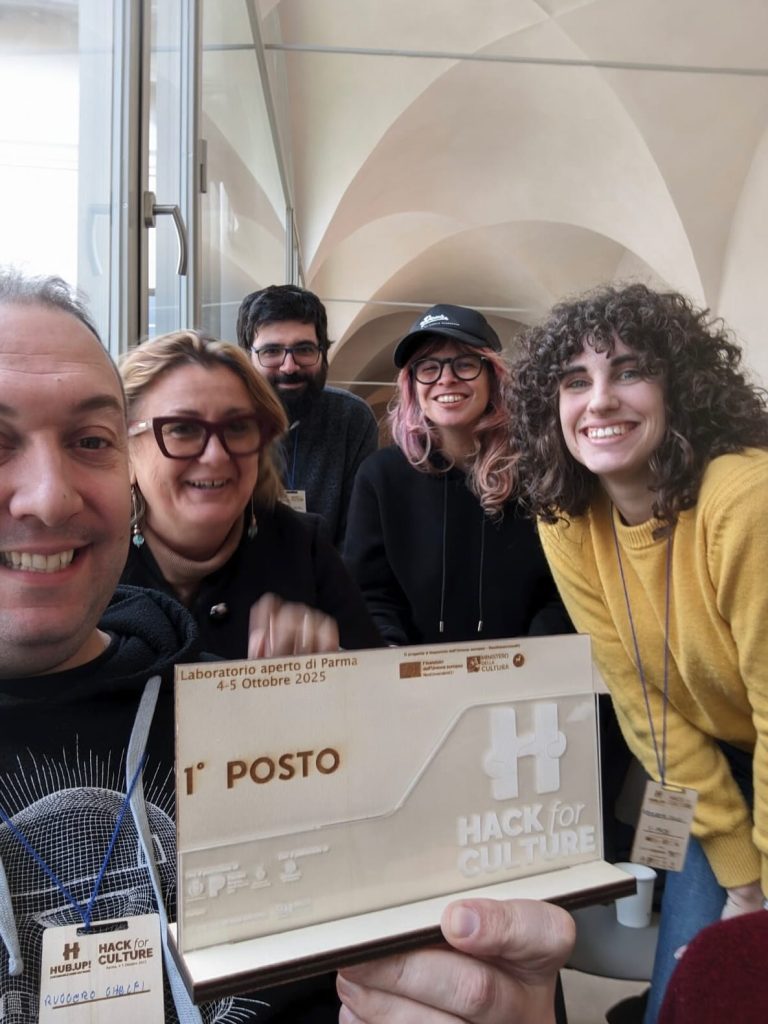
    Four people with a first place placard, standing under a vaulted ceiling.

    This weekend we took part in this hackaton called Hack4Culture: https://officineonoff.com/hub-up-hack4culture-noi-siamo-rigenerazione/

    On Saturday morning, we all met up in the main hall of Laboratorio Aperto, where we shown “inspirational examples”, which were Chiesi Gardens, Start Working Pontremoli, and Kilometro Verde Parma (the latter sounds mostly like green washing to me).

    Then, there was a brief lesson on strategic planning. It started with the impact we wanted to see in the community. Working backwards, we defined what resources we needed to perform activities, what outputs these activities needed to have, and what would be the outcomes that would lead to the desired impact.

    This “canvas” was really not as backwards as it first looked, but it’s very much one of those “you’re selling holes, not drills” kind of things. Following the canvas scheme was one of the 5 parameters that we were told we would be graded on.

    Participants could choose between three case studies, and we had to come up with a project and a communication strategy for it. Two of the case studies were about co-working spaces operated by On Off, one in the city, and one in the plains.

    The third was brought forth by another participant, and it was called Radio Pablo, a community podcasting project aimed at giving a voice to the youth of the Pablo neighborhood, here in Parma. As soon as we heard about this, my mind started swimming with lofty ideas of decentered and geo-located audio distribution systems (I had in mind something like https://blind.wiki/).

    In practice, it was all about making a good pitch for the project, so we started filling out the “canvas”, and checking every box in the evaluation scheme.
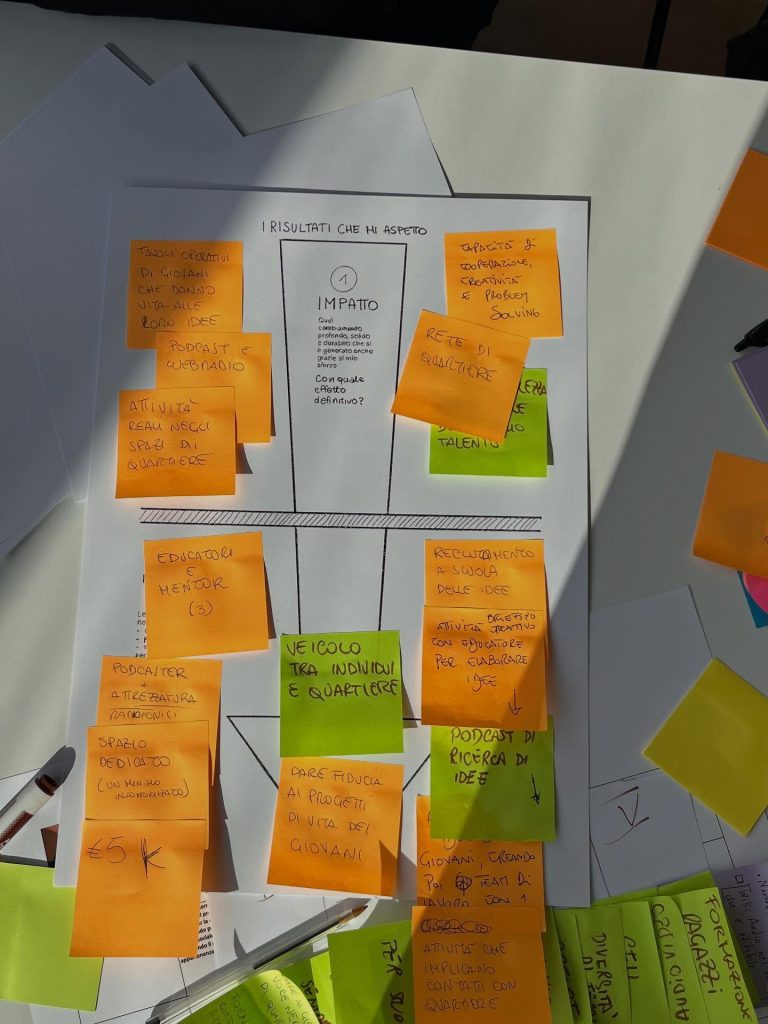
    A "business canvas" articulating the planning of this project

    What was interesting was working with people we didn’t know at all, and finding a synthesis between their genuinely original ideas, and the strategic elements that the judges commented positively about. At one point, we pretty much restarted from scratch when a teammate pointed out that our approach was to have the youths perform work that we deemed important, and to assume that they needed to be taught, almost like they needed to learn a job.

    Saturday evening, we presented our improvised pitch to the mentors, who had very kind things to say, and who pointed out what questions were left hanging.

    After that, Benedetta redid the slide show with coherent graphics, incorporating the advice of the mentors, and we headed to the pub.

    On Sunday morning, 20 minutes before we were supposed to present our pitch, the team hastily changed the tone and order of the presentation, making it more energetic, and switching from just one speaker to a more dialogic format. In the final scheme, the presentation started with a fierce appeal to emotions, followed by Benedetta explanation of the planning and practical steps needed to bring the project to fruition.
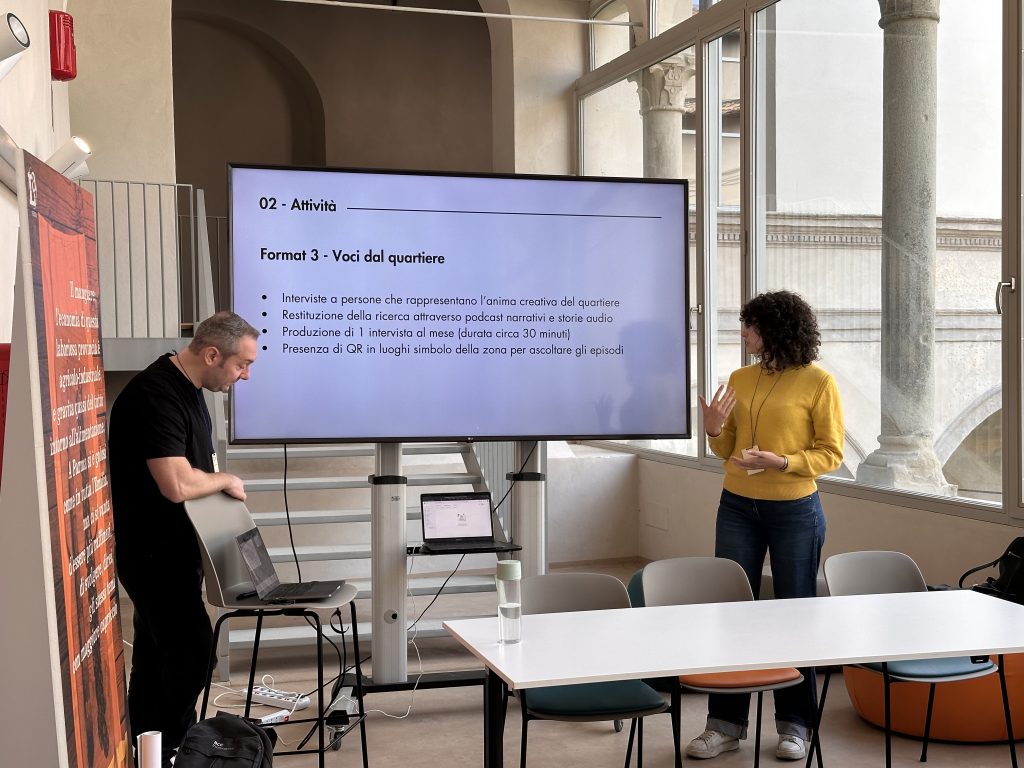
    Benedetta presenting while Ruggero operates the slide show

    Here is the presentation with which we won the first prize. An NGO (APS) will have to be formed for handling the project and actually getting the money. We’re excited to work on this project for real, for now we have this tiny demo of how we want the public history part of the website to look: https://e-muse.it/portfolio/pablo/

    Honestly, if I were a judge I would have voted for Team 3, which did end up winning both the second prize and the special prize for projects targeting “interior areas”.

    A big thank you to the organizers, and to all other participants, it was great meeting people with such a wide array of skills and perspectives.

    There’s also an instagram reel about the event: https://www.instagram.com/p/DPve_DDDBXx
  • Preparing immersive media for the Festival Day

    Preparing immersive media for the Festival Day

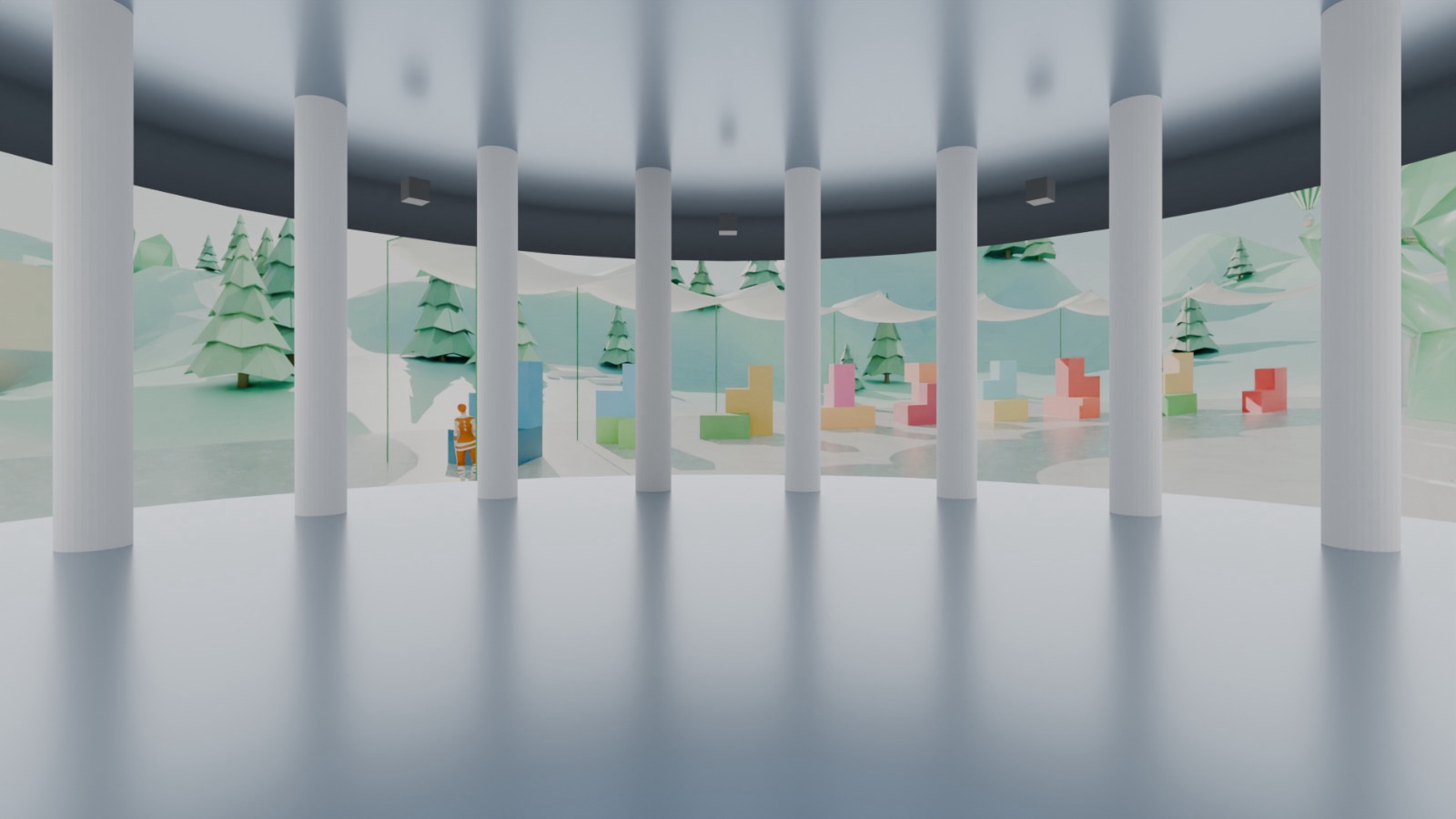
    In one week our work on the BCC Innovation Festival will culminate in an hybrid event, whose physical manifestation will be held in the Salone delle Colonne: an impressive looking immersive room in Rome’s EUR district.

    We are tasked with producing audiovisual material that shows off our immersive experiences in a context that is still immersive, but not interactive. In practice this means producing 360 videos, which have fewer rendering constraints (they don’t have to be executed in real time on random devices), but in which the visitor is less able to look around and explore.

    We’ll make sure to share this video when it is done, but for now I want to share how we managed to preview how the projection was going to look, without going all the way to Rome to try the system out in advance.

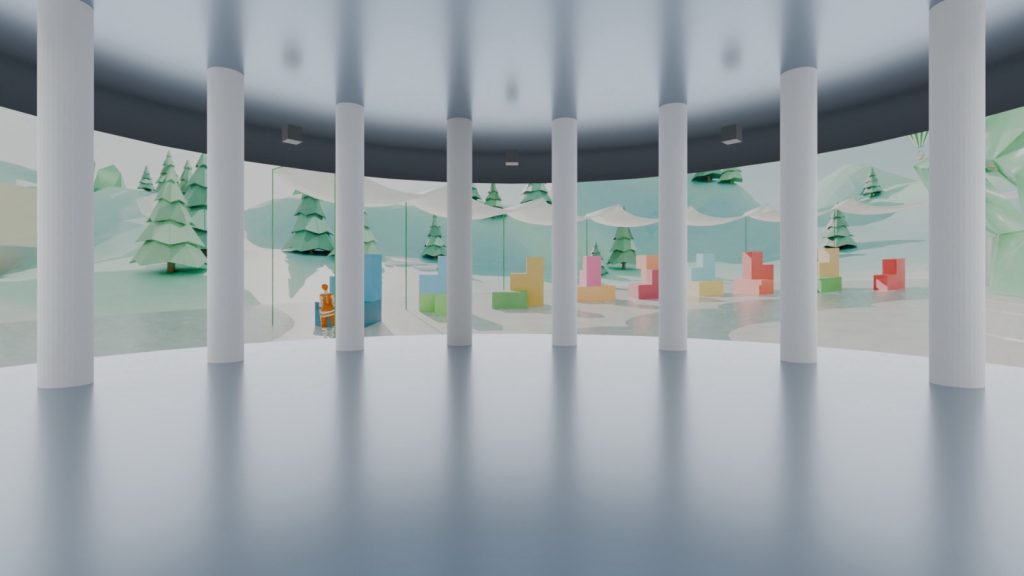
    A quick render of the Salone delle Colonne

    First of all we took the floor map of the space, which was available as a PDF on the venue’s website, we imported into Blender and we modelled a very simple mockup, using just cylinders for the walls and columns, and planes for the ceiling and floor.

    We also put in cubes to represent the positions of video projectors, but we didn’t bother to scale them correctly. We also didn’t model the sort of “steps” with which the ceiling lowers towards the sides of the room, as they don’t interact with the projection geometry.

    So far this was all straightforward modelling, the only somewhat non-obvious thing we did was mapping the 360 video onto the screen.

    We added a new material on the walls cylinder, with an Image texture obtained with an equirectangular camera in our Innovation World Blender scene. (Note: equirectangular cameras only seem to work in Cycles)

    Going into the UV Editing screen in Blender we put a seam on a vertical edge of the screen, and we did an UV > Unwrap. Then we selected all faces, and scaled them on the UV side until the seam matched perfectly. We can then change the center of the projection by moving the UV faces on the X and Y axes.

    We put the resulting Blender file and a GLB on our site, and we also stuck it on Sketchfab for ease of use. We should do a three.js version in which users can load their own files and play around with the projection parameters.

    Geometrically the problem is that the equirectangular video we make in Blender goes from +90 to -90 degrees on the vertical axis, while in the Salone delle Colonne there are something like 29 degrees of vertical elevations, if we look from the center of the room. Actually considering a standing spectator it’s something like +18 to -9 degrees.

    This is of course assuming that the projection has been setup correctly in the room itself. I think ideally the venue should provide examples files, but after all it is a very new installation.

    Similarly the projectors themselves are very advanced, they have an automatic edge and overlap system that we’re very curious to see in action, but it is not quite clear what the logical resolution of the system is.

    Very interesting stuff!

    Edit: I’ve found this article with more technical information on the room’s video system: https://www.sistemi-integrati.net/proiezione-immersiva-di-grande-impatto-nel-salone-delle-colonne-di-roma/

    Edit 2: brief video render