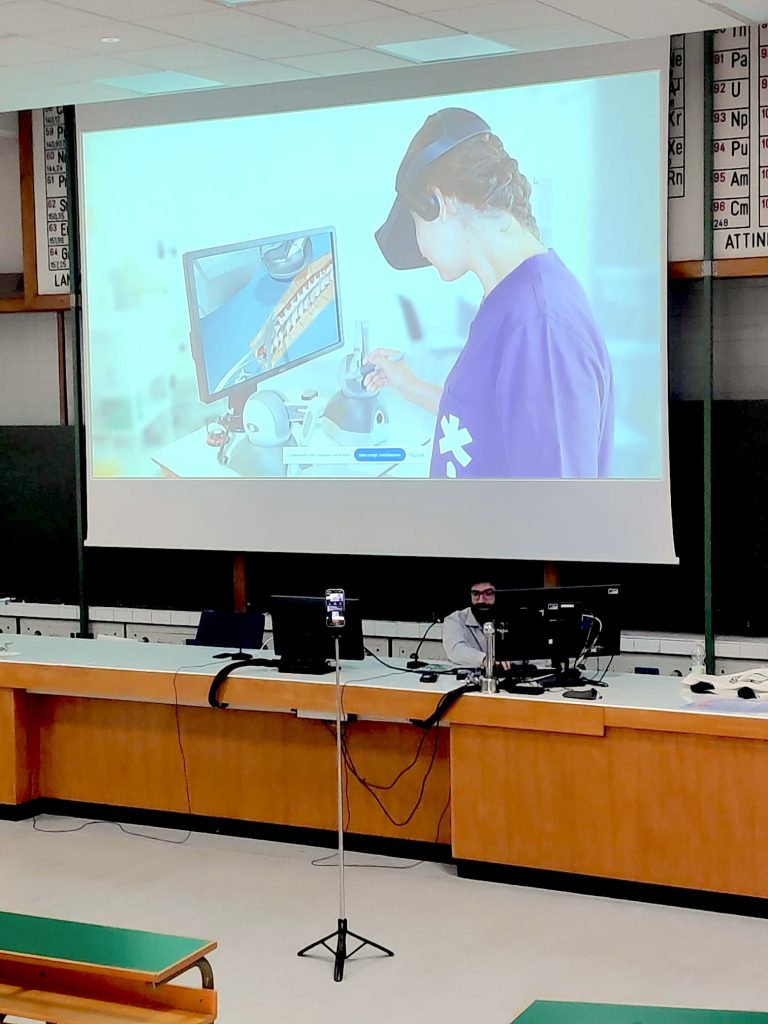
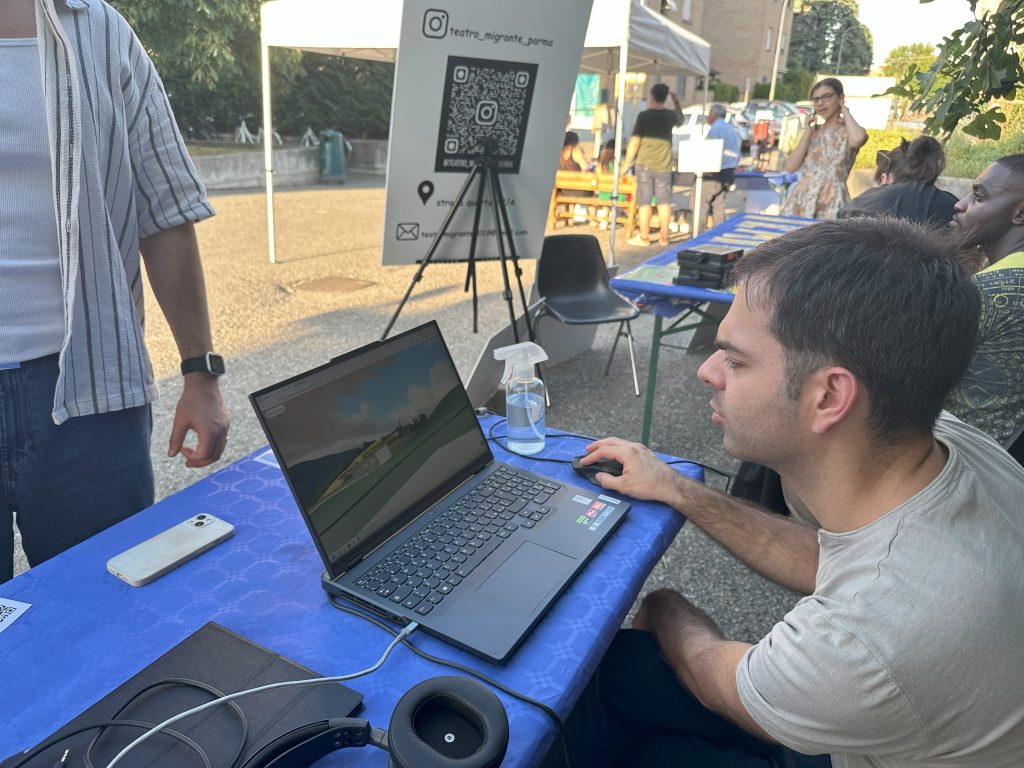
On october 17th we gave two presentations and a few demos at MiniDigital Festival at the University of Parma. We had to use the room’s computer setup due to the streaming setup, which complicated the demo quite a bit, but we made do.
The recordings are available on LinkedIn, starting at around 2h50min.
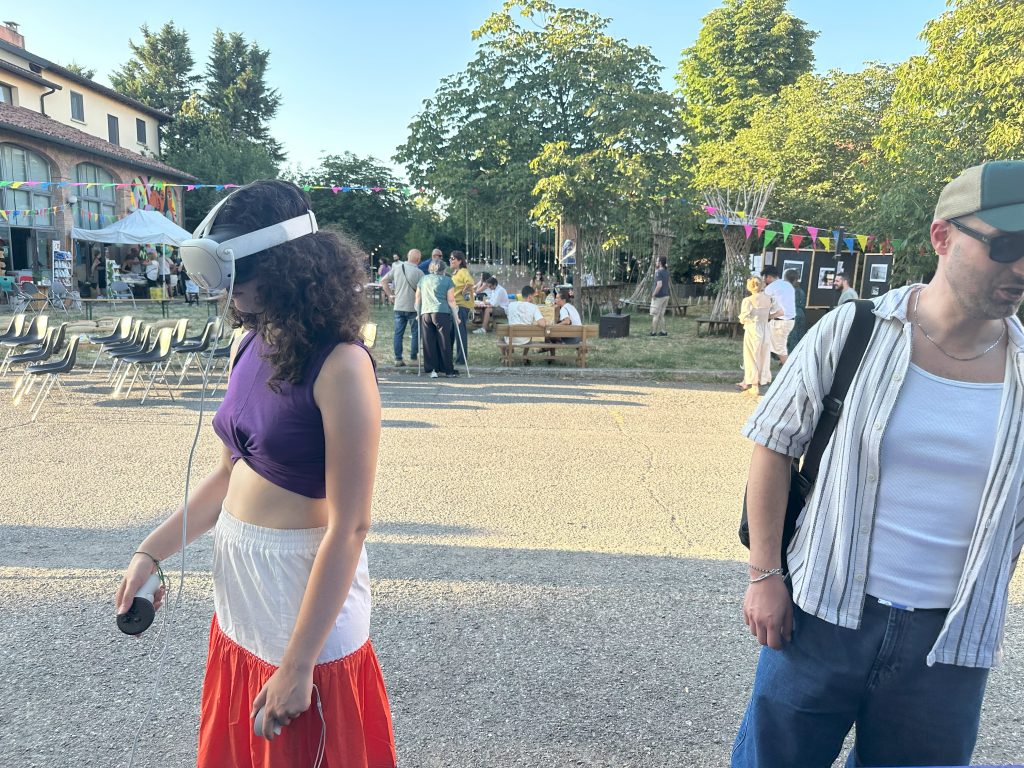
We’ve been part of Officine On Off since October 2024, and last week we participated in their annual festival. There were games, music, and plenty of community feeling.
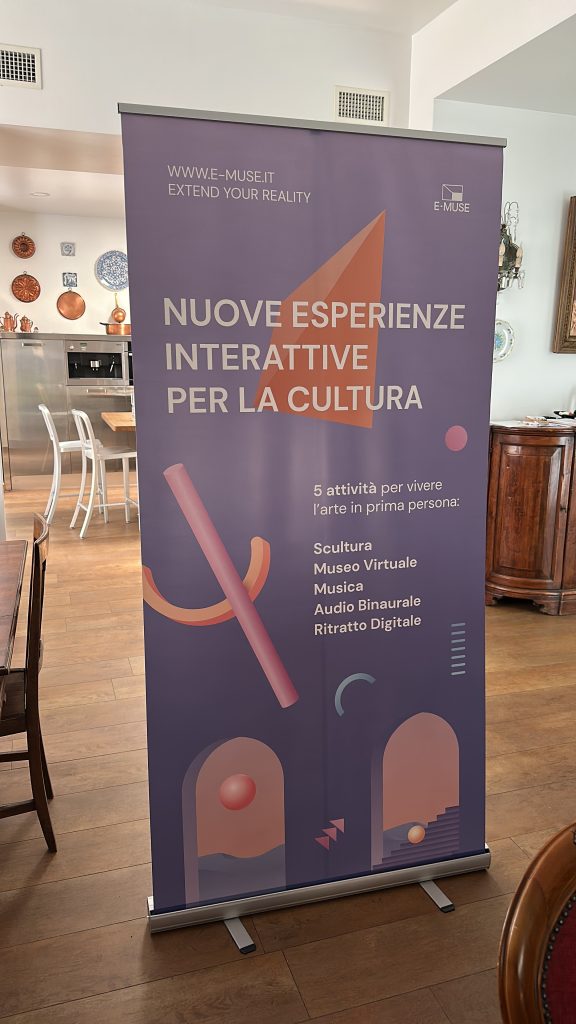
We wanted to bring our A-game, so we even bought a roll-up, which sadly didn’t arrive in time due to a strike.
We had:
3D prints of statues that we had previously digitised, thanks to our dear friend Bonach
A binaural audio guide for one of the 3D printed statues (written by Maura Rossi, with the voice of Chiara Gandini)
An Unreal Engine audio-visual simulation of Piazzale San Francesco in Parma, using data I obtained for Progetto Agorà
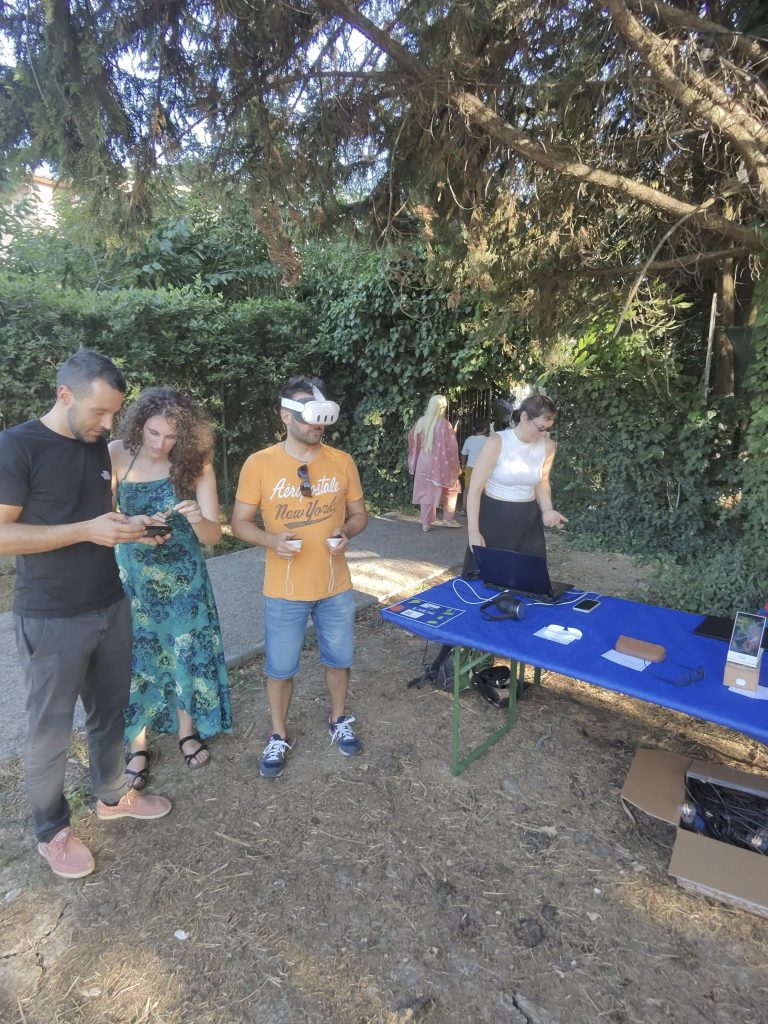
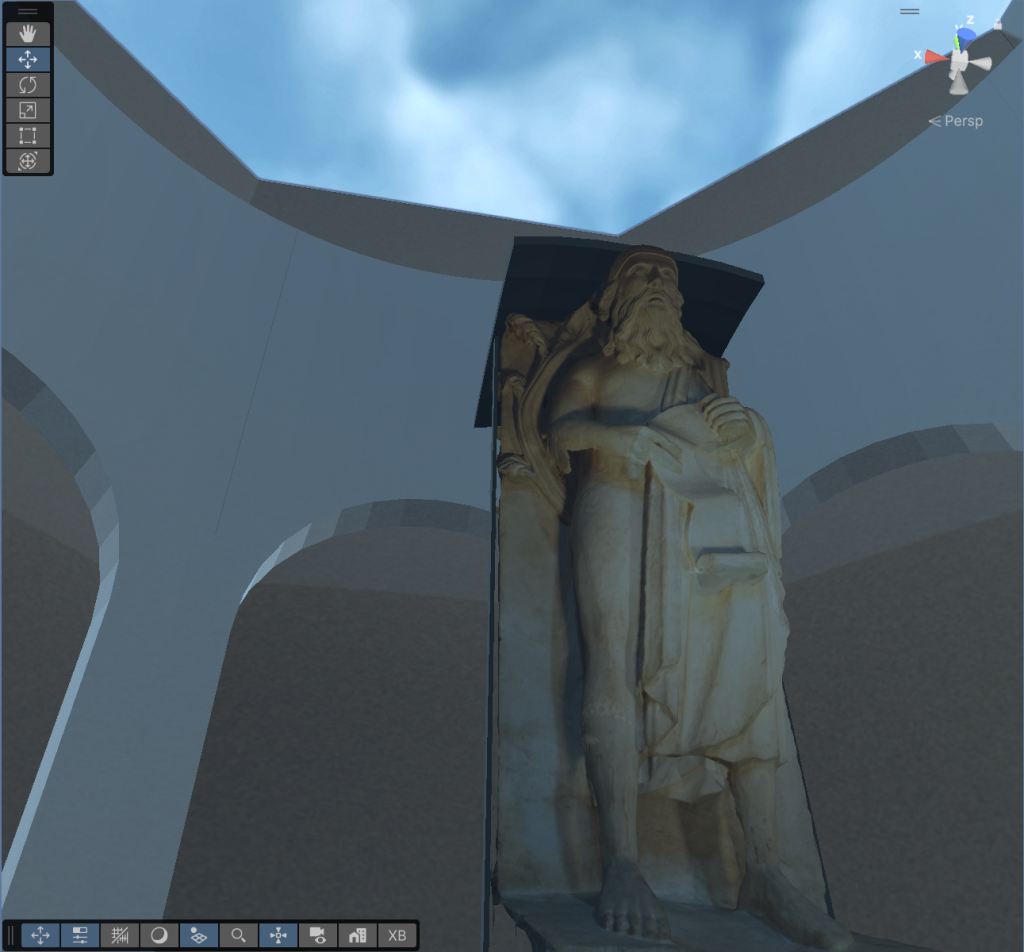
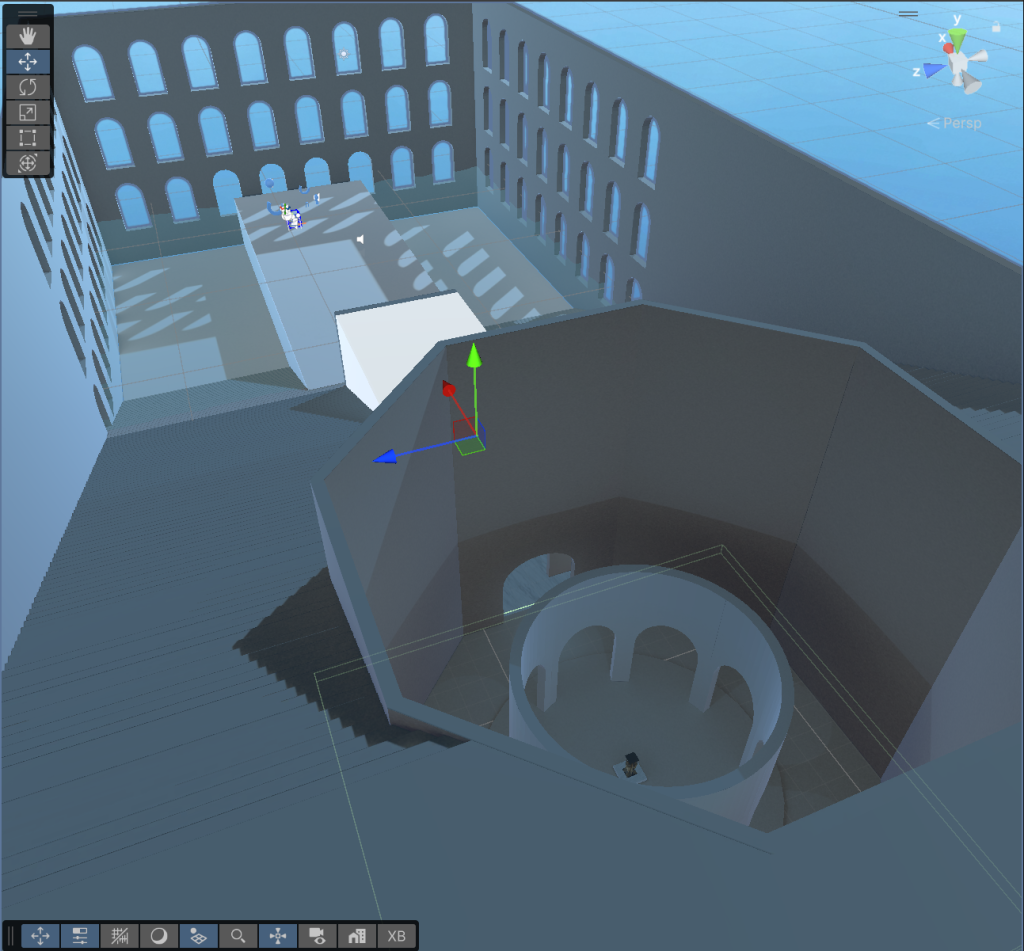
A local version of our Tempietto demo (web version with joystick controls or scrolling along a path), made in Unity, running on a Meta Quest 3, and featuring both the photogrammetry of Antelami’s Winter and the previously mentioned audioguide
360° videos with Ambisonics audio, also running on the Meta Quest 3, mainly from the Verdi 360° project
Despite the scorching weather, we had plenty of people ready to don the VR headset and to try out our demos. The only problem we faced was keeping the battery level up 😀
Kids particularly enjoyed climbing the stairs, then throwing themselves into the void, they were universally delighted by the sensation, which I personally consider stomach-turning 😀
We’ll have to sign up for more in-person demos, they’re just so much fun!
For the 2025 edition of the BCC Innovation Festival, we’re creating a little game, that will act as a sort of on-boarding for people looking to apply.
In this game, a friendly robot will ask the player to solve some riddles and find some objects. This must not interfere with the audio stream, as users can talk to each other.
Whenever the robot gives out information, it has a speech bubble and one of the yap sounds plays. There are several of these, and they’re meant to mimic an explanatory prosody.
Whenever the player provides an incorrect answer, the nay chime is played.
Finally, when a level is completed, we play the yeah sound. This is a longer joyful jingle, which would get annoying pretty quickly if it was overplayed.
All these sounds were created by playing around with the 8-bit instrument package in Logic Pro. Except for the nay, they’re all built around major triads.
We can finally talk about this! (If you look at the tags you might find a few related stealth posts)
For the past year or so, we’ve been working on the cataloguing and digitalization project of the art and cultural heritage assets of the BCC ICCREA group.
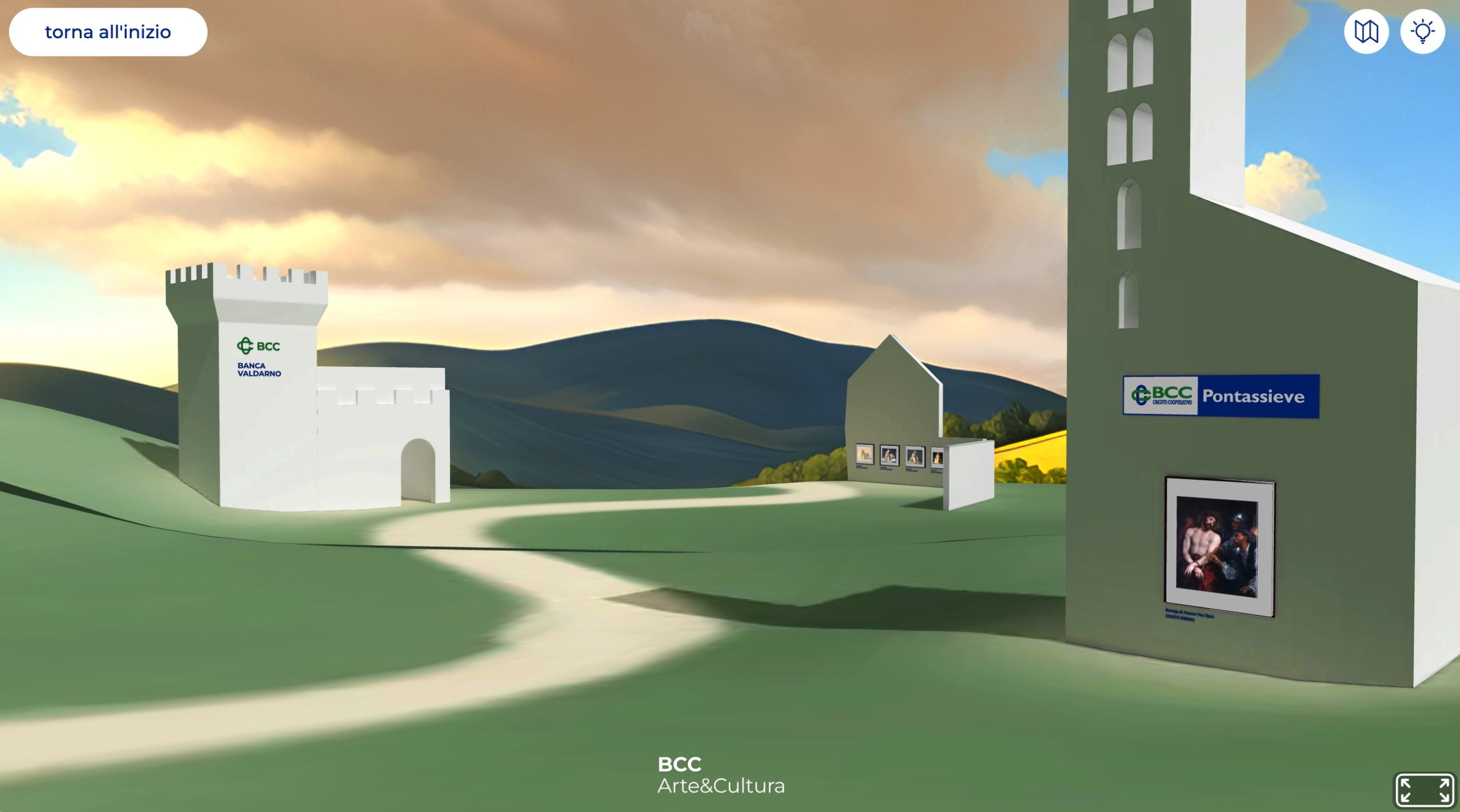
Overall 59 banks and 109 works were included. The results were an art book, a digital catalogue, and a 3D gallery. We created 3D models of buildings and sculptures, we photographed a few paintings, and most importantly we created the 3D gallery.
The project was announced in the rather wonderful Biblioteca Braidense, and it has already gained quite a bit of press:
The other large project we’ve been working on for the past few month is the immersive component of BCC Innovation Festival, the startup festival held by BCC ICCREA. This is a very large conglomerate of what are basically Credit Unions, when translating it into English.
Immersive identity
The concept developed by our clients’ communications department was centered on a low poly theme, and in particular on a low poly version of Rodin’s The Thinker. We created a 3D version of this low poly concept, and we put it in a scrollable three.js webpage, which was then embedded on the homepage of the festival for the vast majority of the festival’s duration. (It has now been replaced with a countdown to the pivotal Festival Day, which is on the 20th of September).
We’ve also created a webAR version (using <model-viewer>), to see the Thinker in your space, which has been featured on the festival’s promotional posters.
We also made 3D printable versions, which were supposed to be handed out to the winners, kind of like Oscar statues, and a massive version that another contractor was supposed to cut out of polystyrene foam, but they were both canceled for cost reasons. As I write this, we’re seriously considering just building a massive cardboard Thinker and bringing it to the Festival Day. It wouldn’t be profitable, but boy would it be cool.
Immersive Experience
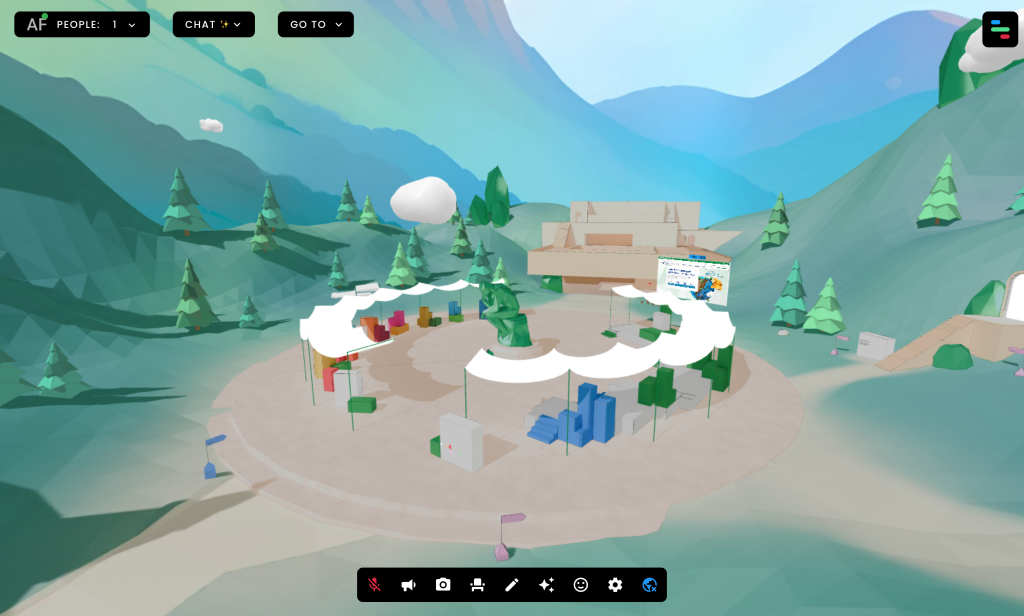
Using FrameVR, we built a 3D world in which all the information about the festival, including the live event during the Festival Day, can be experienced immersively. It’s a webXR experience, so all you need is a browser, it runs on smartphones, computers, and XR headsets. It runs pretty great on both the Quest 2 and the Quest 3.
World building
We designed the environment to foster a sense of exploration. Due to platform limits it was pretty hard to build real interactions, so we basically ended up building a walking simulator. You can walk around, find information about the festival, and most importantly interact with other visitors. People can talk with spatial audio, share whiteboards, stream videos, share their own screens, add 3D models or images. They can personalize their avatars (including with Ready Player Me), and control them through their webcams or through their VR setups.
The whole environment is built in a low poly style, both to match the Thinker and to optimize performance on low-end devices. Apparently there are quite a bit of those among the computers given to our clients by their corporate IT.
Scattered around the environment are some large stones with the same material as the Thinker. Currently we don’t have it enabled to increase signal to noise ratio, but we also tried assigning sounds to each stone, that would trigger when someone walked next to them, creating an harmonic progression.
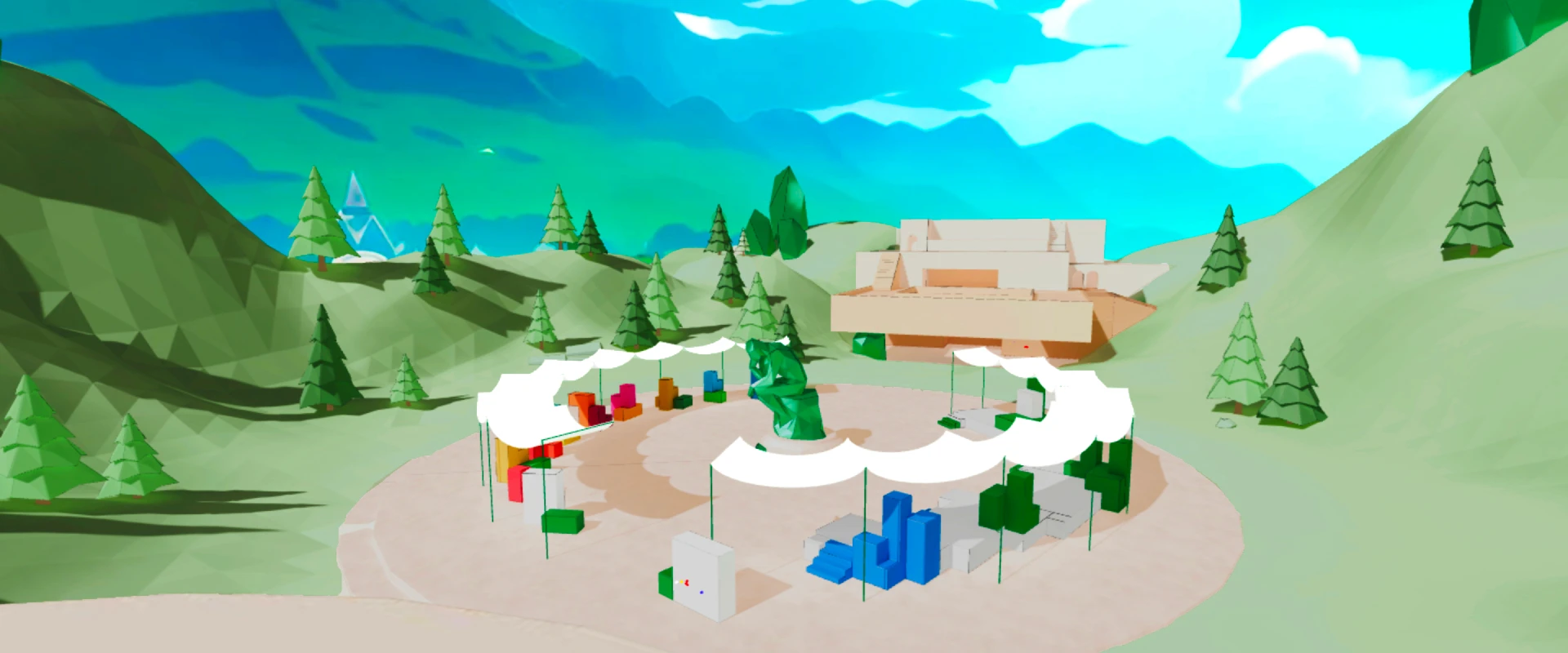
Users start their journey in a small hexagonal corral, filled with a festival timeline and a clickable map. We worry that the clickable map undercuts the sense of wonder and exploration, but it also makes moving around much quicker. Following the path one can reach a panoramic platform, or what we called the Innovation Square, a large concrete circle sitting in a rather wide valley, where a large Thinker acts as a centerpiece.
On the left you can find information about the UN 2030 Agenda for Sustainable Development objectives that all candidate startups (Champions in the BCC lingo) have to pursue in some way.
On the right you can find information about the festival itself, and about the institutional partners.
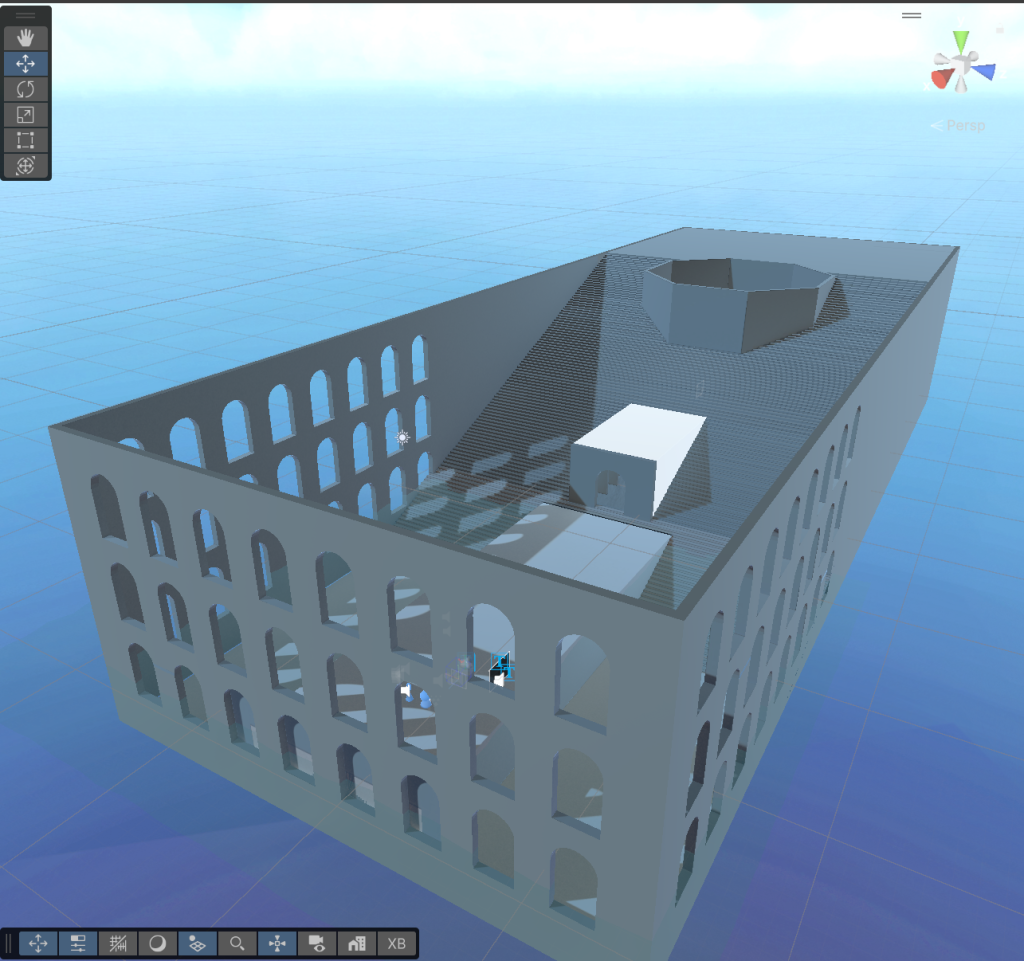
At the far end you can see a large building, creatively denominated “Innovation Building”. It was originally designed as a very permeable space, allowing access from different directions, and ideally the flow of people would be visible from the outside in.
Innovation Building
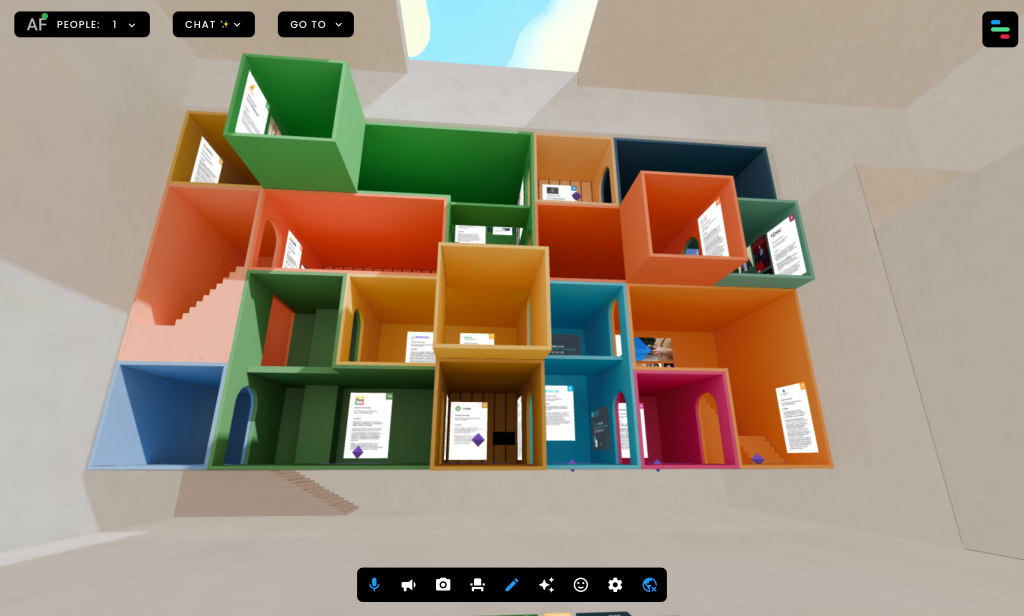
Inside the building itself we had to showcase the startups. They were originally supposed to be 20, but they ended up being 30. They’re classified by UN objectives. This “bento” shape is replicated in two small maps, one on the floor and one on the opposite building, which allow visitors to understand the layout, and to click on them to teleport to the cube they want to visit.
The startups were allowed to send text, images, video, and 3D models to showcase what they’re working on. Sadly, nobody ended up having any 3D material, despite the fact that several worked on domain areas where having a 3D representation would come in quite handy. Quite a few startups provided video, and the spatial audio works great at letting multiple people watch them without interfering with other visitors.
Coming Soon
We also built an Auditorium used for startup-only seminars, and we’ll soon have more to share about the Festival Day, and about the performance of the FrameVR platform.
The first half of this year was taken up by two large projects for BCC ICCREA. We’re doing the immersive components of the BCC Innovation Festival (a startup festival, we were among the winners of the first edition) and of BCC Arte & Cultura (an effort to catalogue the art and cultural heritage artifacts belonging to the banks of the group). For the latter, we went around Italy digitizing the most complex and 3D objects.
All the points we visited
Logistics
At this point it’s not really clear what we’re allowed to publish, as legal departments are surprisingly slow in responding to our queries, so we are going to err on the side of caution. You’ll have to wait until the official announcement before we post the actual works that we’ve digitised, but there shouldn’t be any harm in discussing how we set up the logistics.
Sadly, these locations were largely connected too poorly to attempt to do the whole trip using public transport. We really wanted to be ecological, but we didn’t find a way to do it in the given time and cost constraints without heavily relying on cars.
Once we could confirm the availability of the works on a given day we found cheap accommodations on Booking, loaded all the equipment and all the team members in a car, and we generally tried to avoid traveling during working hours. Northern Italy was covered through a series of short trips, while central and southern Italy were covered sequentially, going roughly clockwise. Some extra trips had to be broken out of the main loop, we managed to make that convenient by relying on some really good friends, who very graciously hosted us.
The whole thing cost us a bit under €2000, which is not too shabby for a 3-person team. This figure includes highways, fuel, accommodation and food, but it does not include the wear and tear on my car. Or the fact that I forgot some lenses at a friend’s place.
What we digitized
Again, we’re not supposed to share images of the works, as many of them are copyright encumbered, so stay tuned for the official launch of the project. I don’t think there’s any arm in sharing a list of what we did, though:
Alla fine del Giorno, Alberto Sughi, oil on canvas
Natività, Ilario Fioravanti, painted ceramics
Presepe, Capuano Brothers, multiple materials
Ducal Palace and several artifacts, in Mafalda
Ut Unum Sint, Arnaldo Pomodoro, outdoor metal stele
Bank building, Ugo Pagliara, building and architectural drawing
Carrù Castle, building
Chandelier made of Murano glass, 3 paintings, near Venice
Acquaviva Picena, whole building (we ended up scanning the whole town)
Incontri al Maneggio, Silvano Spessot, iron and colored glass sculpture
Untitled, Nane Zavagno, steel sculpture
Pinocchio, Venturino Venturini, bronze sculpture
Sant’Antonio Abate, Luca della Robbia, painted ceramics
Bank builiding, part of the Gradara castle-town
Bank building in Alba (no drones for this one, we had to climb literal towers!)
Assalto all’Olimpo, Bruno Liberatore, bronze sculpture (a much larger version is in Rome)
Untitled, Cesare Berlingeri, bent and stacked colored paper
An archeological site in Rome, featuring Imperial-age fresco-ed walls and a very well preserved Roman road
People expected big changes after the release of the Apple Vision Pro, and some are visibly disappointed. Apple tends to have a big effect on the mainstream, lots of people seem to think that they invented the smartphone, when the iPhone came out I was using my third smartphone.
XR technology has been commercially available for 30 years, it tends to progress in the same way that people go bankrupt: gradually, then suddenly.
We’re seeing some pretty interesting gradual changes, particularly in terms of software platforms. The Apple partnership seems to really have pushed Unity into high gear, they’re releasing a lot of resources, both on the editor side and on the design side. Sadly some of the best stuff is reserved for paying customers, and it’s pretty expensive.
This seems to also have changed the thinking on the Sony (with the opening up of PSVR2 to PC users) and Meta. In just a few days Meta announced a radical opening up of their efforts.
First of all they announced a new educational project, which will probably increase the demand for the kind of work we do quite a bit. The fundamental problem is that they keep using the “metaverse” word, and quite a few people have a very negative reaction to it. The concept is really not that clear, but the educational uses of VR are real, hopefully if there is an educational sales push it will also benefit us.
The most important announcement is the opening up of their operating system. It will be possible to buy compatible headsets from other manufacturers, which should keep prices affordable without selling hardware at a loss, and even more importantly they’re opening up the app store. Multiple stores will be available, which could several important advantages. We could have a cross-platform cultural heritage app store which encourages reuse. Or more prosaically, maybe I could use some of my SteamVR purchases.
Zuckerberg is explicitly aiming at providing the Windows of the XR market. At the same time, these changes should make them entirely Digital Markets Act compliant.
We started this company by winning the Bain award at the original BCC Innovation Festival, back in 2022. In a bit of a homecoming, we were tapped to provide immersive services for the next edition of the Festival.
Il Pensatore: an immersive landing
Following the concept from BCC’s own creative department, we created a low-poly version of Rodin’s Le Penseur. In the original concept art the statue was 3D printed, clearly showing the signs of a filament printer. Our own version was materialized with a resin printer:
This model became a sort of leitmotif of the whole immersive experience. We changed the texture to a brushed metal in the corporate green, and we provided the client with renders for web and print channels.
We then proceeded to make this model available in webAR, using the model-viewer library. This will be used in an upcoming promotional campaign, asking the public to share pictures of the statue in their environment, a bit like we did with the whale for the Leverans comic.
We then created the scrollable section of the festival homepage, using a threejs scene embedded in an iframe. All semantically meaningful elements were implemented as standard DOM elements, the 3D is purely decorative, but it does not detract from the accessibility of the content.
We also built a virtual world on framevr. The design goal was to let users interact in a shared explorable space. We’re pretty proud of the work our architect did, and there is some technically clever work on object instancing, but we’ll have here write a whole post on the matter. Keeping to the high level concept, we have a pretty linear progression from the starting point to the exhibition area, gradually disclosing information to the visitor no matter what path they choose.
We worked pretty hard to balance visual quality with performance, and we can now confidently state that it will work on whatever device you use.
Geodesic rocks in the same material as the Pensatore were inserted throughout, and to tie the concept together we made this short video (pretty early in the process, a lot of the environment is missing):
Please do check out BCC Innovation World, we’ll be expanding it a lot in the next few months.
The Apple Vision Pro launch seems to have brought a lot of of interest, which is to be expected when Apple does, well, anything.
They even came up with their own marketing-infused grammar, they want people to say Apple Vision Pro, never the Apple Vision Pro.
Some of the discourse has veered into worries about people wearing visors while driving, luckily those are just a handful of attention seekers.
Technical Analysis
First of all, how is it built? iFixit to the rescue:
It would seem that finally the screen resolution and clarity are sufficient for the “lots of virtual screens” use case. Last year Karl Guttag evaluated the angular resolution of the Apple Vision Pro as between 35 and 40 PPD (pixels per degree). In the above iFixit video it’s measured at 34 PPD, so that was spot on.
On the development side, Unity support is now out of beta, but it is only available for Pro users ($1800/year). So for most developers the choice is between the native Apple SDKs and WebXR. The latter enables us to develop once, and run on every device, so it is clearly superior.
There has also been some debate on Spatial Video, namely whether it is simply a stereoscopic image, or if there is some parallax magic. As always with immersive video, Hugh Hou has the last word:
The fundamental distinction is between “windowed” apps, that are limited on a virtual screen, and actual VR apps. The beauty of Reality Kit is the ability of having spatially-aware elements in apps that still work with passthrough.
Puzzling Places is one of the best Quest apps, from one of the best photogrammetry teams in the world, so it’s not a surprise to see them be successful on the Apple Vision Pro